Introduction
The financial world is undergoing a massive transformation, and at the heart of this change lies Ethereum. Unlike traditional systems that rely on banks, paperwork, and middlemen, Ethereum introduces efficiency, transparency, and global accessibility. These are not minor perks—they are Powerful Ethereum Advantages capable of fundamentally reshaping how money and digital assets flow worldwide.
Ethereum is not just a cryptocurrency. It is a programmable blockchain platform that allows developers, companies, and governments to build decentralized applications (dApps), smart contracts, and tokenized assets. The Powerful Ethereum Advantages discussed in this article are changing the financial landscape, creating new opportunities for innovation, investment, and economic inclusion.
In this article, we’ll explore seven Powerful Ethereum Advantages, explain why they matter, highlight real-world examples, and examine what the future might hold for Ethereum and the global economy.
What Sets Ethereum Apart from Other Cryptocurrencies?
Before diving into the Powerful Ethereum Advantages, it’s important to understand why Ethereum stands out from Bitcoin and other cryptocurrencies.
Bitcoin is primarily a digital store of value, often referred to as “digital gold.” Its key strengths lie in scarcity, security, and stability as a decentralized currency. Ethereum, however, goes further: it is a programmable blockchain. Developers can build smart contracts, dApps, and tokenized assets on top of Ethereum’s network, creating an entire decentralized economy.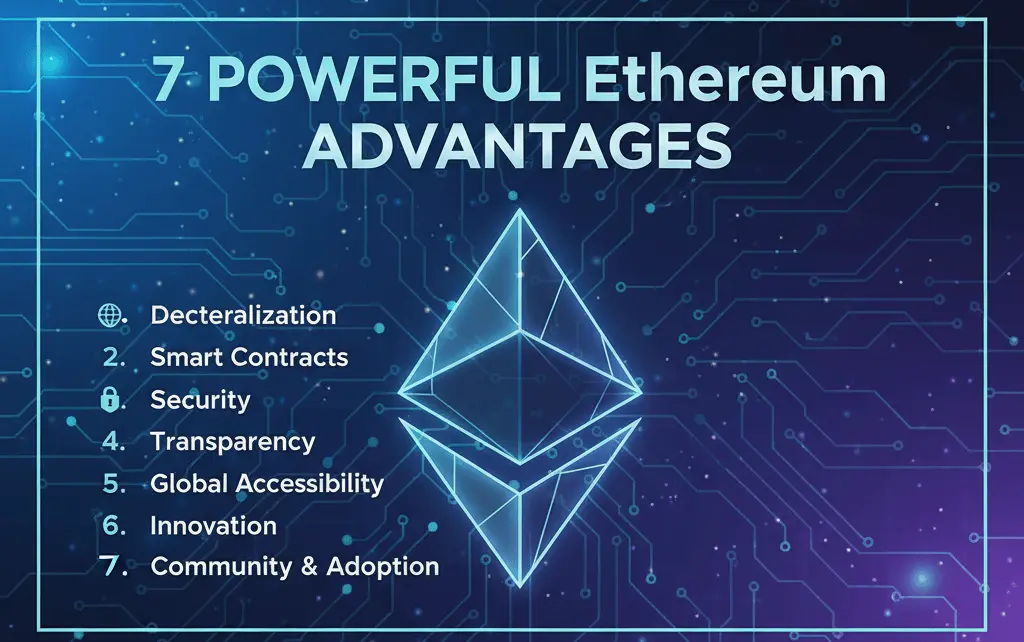
This programmability is a core reason why Ethereum has multiple Powerful Ethereum Advantages. While Bitcoin proves that decentralized money can work, Ethereum proves that an entire decentralized financial and digital ecosystem can thrive.
The 7 Powerful Ethereum Advantages
1. Smart Contracts and Automation
One of the most transformative Powerful Ethereum Advantages is the ability to create smart contracts. These are self-executing agreements with the terms directly written into code. Once predefined conditions are met, the contract executes automatically, eliminating the need for intermediaries like banks, lawyers, or brokers.
For example, a real estate purchase on Ethereum can automatically transfer ownership to a buyer once payment is confirmed, reducing costs, time, and fraud risk. Similarly, insurance claims can be processed instantly when certain criteria are met, streamlining operations and improving customer satisfaction.
Smart contracts are used across industries including finance, healthcare, logistics, and supply chain management. The automation, transparency, and trust enabled by smart contracts are among the most impactful Powerful Ethereum Advantages, saving billions in operational costs globally.
2. Decentralized Applications (dApps)
Another standout among the Powerful Ethereum Advantages is Ethereum’s support for decentralized applications, or dApps. Unlike traditional apps that rely on centralized servers, dApps run on Ethereum’s blockchain, making them transparent, censorship-resistant, and operational even if some servers fail.
Gaming, social media, finance, and healthcare industries are rapidly adopting dApps. For example, games like Axie Infinity allow players to truly own in-game assets through NFTs, while DeFi dApps enable peer-to-peer lending without banks.
The growth of Ethereum’s dApps ecosystem demonstrates one of the most versatile Powerful Ethereum Advantages: the ability to create real-world applications that empower users globally and drive blockchain adoption.
3. Decentralized Finance (DeFi)
Decentralized finance, or DeFi, represents a groundbreaking Powerful Ethereum Advantage that challenges traditional banking. Ethereum-based DeFi platforms allow users to lend, borrow, trade, and earn interest on digital assets without a centralized institution.
For instance, protocols like Aave, Compound, and MakerDAO allow individuals to earn interest or take loans using cryptocurrencies as collateral. These platforms operate 24/7, offering financial services to billions of people who are underbanked or unbanked.
DeFi has grown exponentially, with billions of dollars locked in Ethereum smart contracts. This growth highlights Ethereum’s ability to provide financial independence, reduce reliance on banks, and open up new avenues for global economic participation—a core Powerful Ethereum Advantage.
4. Security and Transparency

Security is a key pillar of the Powerful Ethereum Advantages. Ethereum transactions are recorded on a blockchain, an immutable and transparent ledger. Once a transaction is confirmed, it cannot be altered or reversed.
This immutability prevents fraud, double-spending, and unauthorized access. Unlike centralized systems, which can fail at a single point, Ethereum’s decentralized structure ensures resilience against hacking. Cryptography secures user funds, protecting digital assets with private keys that only the owner controls.
This transparency and security make Ethereum not just a technological innovation but also a trusted platform for global finance, reinforcing its position as a cornerstone of the decentralized economy.
5. Ethereum 2.0 and Scalability
Ethereum has historically faced scalability challenges, but the launch of Ethereum 2.0 is turning this into a Powerful Ethereum Advantage. Ethereum 2.0 replaces Proof-of-Work (PoW) with Proof-of-Stake (PoS), drastically reducing energy consumption while increasing transaction throughput.
Lower energy usage makes Ethereum environmentally sustainable, while faster transaction processing enhances user experience. Upgrades also reduce transaction costs, making Ethereum more accessible to a global audience.
Ethereum 2.0 ensures that the network can handle millions of users, thousands of dApps, and increasing DeFi activity—solidifying the long-term relevance of these Powerful Ethereum Advantages.
6. Global Accessibility and Financial Inclusion
Another socially transformative Powerful Ethereum Advantage is global accessibility. Anyone with an internet connection can participate in Ethereum’s ecosystem. You don’t need a bank account, government-issued ID, or permission from a financial institution.
This inclusivity is crucial for billions of unbanked or underbanked individuals worldwide. Through Ethereum, they can save, invest, transact, and access financial services without traditional barriers.
By empowering individuals to control their assets and participate in global finance, Ethereum is driving financial inclusion—a fundamental Powerful Ethereum Advantage that can reshape economies and reduce poverty.
7. NFTs and Tokenization
NFTs (non-fungible tokens) and tokenization showcase Ethereum’s versatility. NFTs allow users to prove ownership of digital assets, from art to music to virtual real estate, while tokenization enables physical assets like property or stocks to be represented digitally.
Ethereum hosts most NFT projects, enabling artists, developers, and investors to create, sell, and trade digital assets globally. Tokenization also allows fractional ownership, making previously inaccessible investments available to a wider audience.
This ability to digitize ownership and value demonstrates one of the most revolutionary Powerful Ethereum Advantages, extending Ethereum’s impact beyond finance into art, real estate, and intellectual property.
Additional Powerful Ethereum Advantages
Beyond the seven main benefits, Ethereum has several additional Powerful Ethereum Advantages:
Liquidity: Ethereum is one of the most traded cryptocurrencies, ensuring easy conversion to cash or other digital assets.
Portability: Large amounts of value can be stored in a small hardware wallet or a simple seed phrase.
Developer Ecosystem: Ethereum has one of the largest blockchain developer communities, ensuring continuous innovation.
Interoperability: Ethereum projects can integrate with other blockchains, expanding the ecosystem and use cases.
These additional advantages make Ethereum adaptable, resilient, and future-proof in the rapidly evolving digital economy.
Challenges Facing Ethereum
While Ethereum’s advantages are significant, challenges remain:
Gas Fees: High network fees can deter small transactions.
Competition: Platforms like Solana, Cardano, and Polkadot provide faster and cheaper alternatives.
Regulation: Governments worldwide are still defining cryptocurrency regulations, which could impact Ethereum adoption.
Despite these challenges, the ongoing upgrades and growing adoption reinforce Ethereum’s ability to maintain its Powerful Ethereum Advantages.
Ethereum vs Traditional Finance
Ethereum offers several advantages over traditional finance.
| Feature | Traditional Finance | Ethereum (Blockchain) |
|---|---|---|
| Availability | Limited to business hours | 24/7 global access |
| Costs | High fees, middlemen | Lower costs, fewer intermediaries |
| Transparency | Opaque, centralized | Public, verifiable ledger |
| Accessibility | Bank account required | Internet connection needed |
| Settlement Speed | Days to process | Minutes |
This comparison highlights how Ethereum provides faster, cheaper, and more inclusive solutions—further proving its Powerful Ethereum Advantages.
Real-World Applications
Some notable examples of Ethereum’s Powerful Ethereum Advantages in practice:
DeFi Platforms: Aave, Compound, and MakerDAO provide decentralized lending and borrowing globally.
NFT Marketplaces: OpenSea and Rarible enable digital art sales and ownership.
Enterprise Adoption: Microsoft, JPMorgan, and ConsenSys are building enterprise applications on Ethereum.
Global Remittances: Ethereum allows fast, low-cost international money transfers compared to banks.
These examples demonstrate how Ethereum is already reshaping industries.
FAQs on Powerful Ethereum Advantages
Q1: Why are the Powerful Ethereum Advantages important?
They demonstrate Ethereum’s ability to reduce costs, improve transparency, and provide global financial access.
Q2: Is Ethereum better than Bitcoin?
Ethereum offers smart contracts and dApps, while Bitcoin focuses on store-of-value and scarcity. Both have unique advantages.
Q3: Can Ethereum replace banks?
It can’t fully replace banks yet but can significantly reduce reliance on traditional financial institutions.
Q4: Are the Powerful Ethereum Advantages secure?
Yes, Ethereum uses blockchain immutability and cryptography for high security.
Q5: Which industries benefit most?
Finance, gaming, real estate, healthcare, supply chain, and digital art all benefit from Ethereum.
Conclusion
Ethereum is more than a cryptocurrency—it is a platform for innovation, inclusion, and economic empowerment. Its Powerful Ethereum Advantages—from smart contracts and dApps to DeFi and NFTs—are transforming industries and global finance.
By enabling transparency, decentralization, and financial accessibility, Ethereum is laying the foundation for a new digital economy. As adoption grows and upgrades continue, these advantages will only become stronger, making Ethereum a pivotal player in the future of money and global finance.
Whether for DeFi, tokenization, or enterprise applications, Ethereum proves that its Powerful Ethereum Advantages are shaping the next generation of financial systems, digital ownership, and technological innovation.