Introduction
In just a few years, Pi coin has gone from being a mobile-mining hype project to one of the most controversial and widely discussed crypto-projects. Pi’s price dynamics are unlike those of a coin that was fully tradable from day one because of a massive built-in user base from the smartphone mining era, phased mainnet launches, and staggered exchange listings. Nowadays, Pi coin is traded on a few different exchanges, showing real market prices, liquidity, and volatility, which makes it possible to create forecasts, albeit with a high degree of uncertainty.
Presently, PI coin is priced at a few dollars or tens of cents on different trading platforms (real-time feeds and market pages show PI coin at around ~$0.20 as of Oct 17, 2025).
This article:
- Explains Pi’s present market and product context and the resulting price impact.
- Details the key factors that could see PI coin reaching various price levels by 2030.
- Illustrates three definite scenarios (Bear/Base/Bull) along with a 2025–2030 projection table.
Step-wise logic for the Base scenario (my working projection) and a short strategy checklist for the readers are also provided.
Quick status snapshot (what’s true now)
Pi tokens are available for trading at various centralized exchanges, and price pages illustrate real-time PI market activities. Market pages like OKX, Gate,e, and CoinGecko display PI with quoted USD prices and trading volumes.
- Pi’s mainnet and token economy journeyed through significant milestones in 2024-2025, and the project’s launch cadence – KYC, token distribution rules, and app features – timeline of tokens entering tradable liquidity pools was directly influenced by the way the tokens were released. The mainnet launch and its market impacts were covered by the crypto press.
- Major exchanges have either thought about or held community votes regarding the listing of PI coin (reported were Binance community votes and other listing interests), thereby indicating demand but not automatically leading to long-term liquidity or regulatory approval.
These points form the base of any projection — if there is a significant change in listings, tokenomics, or user engagement, then the scenarios outlined below need to be re-evaluated.
How we’ll forecast: methodology & caveats
Forecast methodology (concise)
Predicting the value of a crypto token that resulted from a mobile network with a high number of users means taking into account the following:
- On-chain and tokenomics analysis — supply caps, vesting, and release schedules.
- Liquidity/market metrics — exchange listings, 24h volume, orderbook depth.
- Adoption signals — active wallets, app usage, and developers building Pi apps.
- Macro crypto environment — BTC cycles, regulatory shifts, global liquidity.
- Comparative analogs — cases like Dogecoin (community-driven liquidity), and new token launches that rode network effects.
I come up with three scenario paths (Bear / Base / Bull) along with numeric projections for each year 2025–2030. The Base scenario is based on gradual adoption and continued listings; the Bull on rapid adoption, major exchange listings, and network utility; and the Bear on limited real-world usage, regulatory headwinds, and selling pressure from early token holders.
Important caveats
- This is not investing advice. Treat scenarios as conceptual models rather than definite outcomes.
- Token prices are very volatile and can be affected by sudden supply shocks (e.g., mass KYC completions or unlocked vesting) without warning.
- There have been some significant discrepancies between what different market pages have reported; hence, it is always good practice to verify the exchange order book for liquidity before taking any action.
Key drivers that will determine PI coin 2030 price
Real active user adoption & retention
If millions of daily active users adopt Pi apps, use PI coin for payments, and engage in marketplaces/DeFi inside the Pi ecosystem, demand will soar. On the other hand, if the number of active users drop,s terminates or fails to transform inteconomicic activity, the price will come under pressure.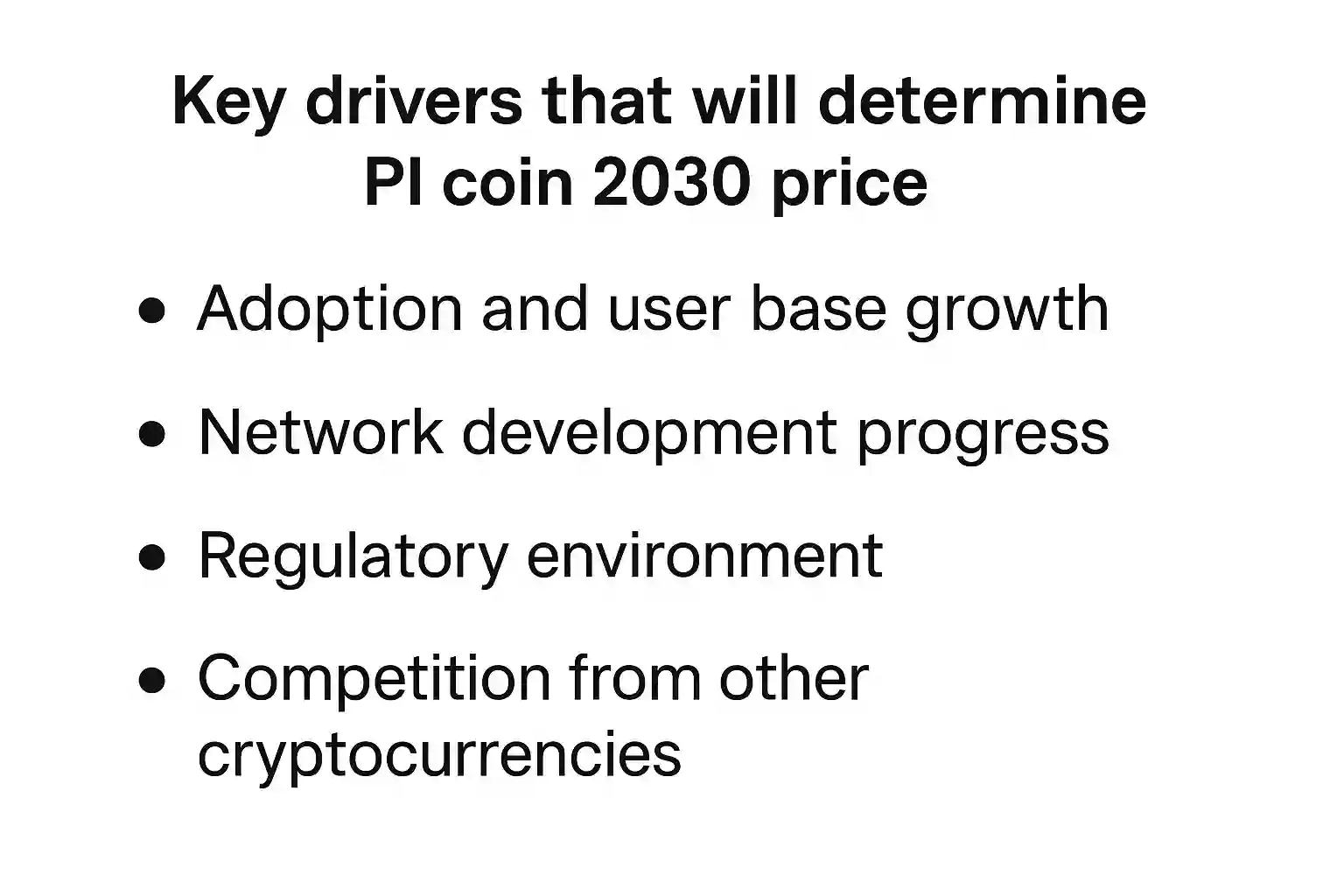
Tokenomics: supply, unlock schedules, and distribution fairness
One of the main factors is how much PI coin is out there and how much is still in the wallet, and also the rules regarding the unlocking of early-mine allocations. Massive and badly timed unlocks can cause dumping; however, if the unlocking is done slowly and thoughtfully, it can lead to a price increase.
PI Coin Exchange listings and liquidity
Good listings on major exchanges (e.g., Binance, Coinbase, OKX) will greatly increase both retail and institutional access; however, a listing by itself is not enough. Liquidity and market-maker support are what really determine whether price increases can be sustained. Community riding voting has been a way for the exchanges to measure the interest; however, the exchanges give regulatory and technical factors more weight for the final decision.
Regulatory environment
Global regulators differ in how they treat tokens. If Pi coin gets a favorable regulatory classification in the major jurisdictions or is quick with the compliance of the AML/KYC standards, then this would remove a significant blockade on institutional flows.
Product Utility/Developer Ecosystem
If Pi turns out to be a platform for applications (payments, micropayments, DeFi, NFTs, remittances), then it is bound to have recurring on-chain demand. Side-by-side with mobile payment processors and the real-world integration would double the transaction velocity and demand.
Macro crypto market sentiment
Will BTC stay dominant? Will there be risk appetite? What will be the interest rates? And what about the geopolitical capital flows? Among other things, these factors determine the size of speculative allocations. Even the best fundamental project can be pulled down during a market-wide crash.
Three scenario projections (2025–2030)
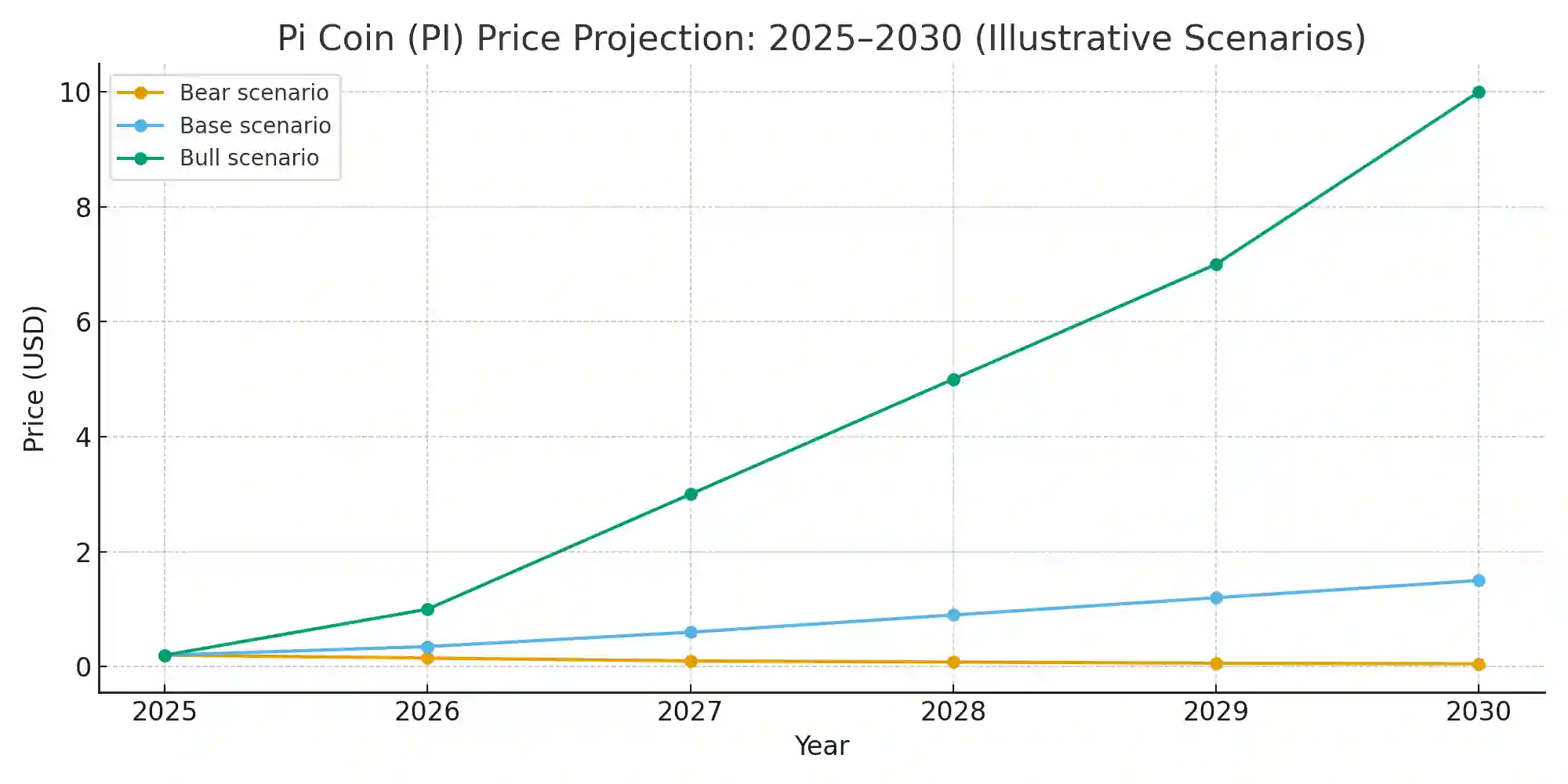
The PI coin price 2030 illustrative scenario endpoints are shown below:
- Bear scenario (the worst case): $0.03 – $0.10 (structural weak adoption, heavy sell pressure)
- Base scenario (most likely moderate case): $1.00 – $2.50 (steady adoption, gradual DeFi/apps growth)
- Bull scenario (optimistic case): $5 – $15+ (widespread global utility, major exchange + institutional flows)
The ranges reflect a blend of tokenomics, market share assumptions, and macro sensitivity. The remainder of the article describes the various ways each route can take and provides year-by-year tables and charts.
Yearly table: Pi Coin Price Prediction
| Year | Bear scenario (USD) | Base scenario (USD) | Bull scenario (USD) |
|---|---|---|---|
| 2025 | 0.20 | 0.20 | 0.20 |
| 2026 | 0.15 | 0.35 | 1.00 |
| 2027 | 0.10 | 0.60 | 3.00 |
| 2028 | 0.08 | 0.90 | 5.00 |
| 2029 | 0.06 | 1.20 | 7.00 |
| 2030 | 0.05 | 1.50 | 10.00 |
(Table is illustrative — numbers chosen to show plausible divergent outcomes from identical starting points. Base scenario presumes modest adoption growth; Bull assumes network adoption accelerates, and PI coin finds significant on-chain utility.)
The chart: Three scenarios
I created a local illustrative projection chart that visually displays the Bear / Base / Bull PI coin (2025–2030) trajectories.
How the Base scenario turns out to be the “working” forecast (the step-by-step reasoning)
The Base case (PI coin around $1.50 by 2030 in the example with the table) is the median path if:
- Gradual real-world utility emerges — Pi apps, simple payment rails, and micro-merchants start accepting PI; network activity increases but at a moderate pace.
- Listings grow cautiously — PI coin gets listed on more reputable exchanges, thereby enhancing liquidity, but without immediate institutional over-exposure that would result in speculative mania and subsequent crash.
- Tokenomics stay limited — the unlock schedules are staggered, the KYC processes help limit the number of fake accounts, and the team/vested tokens are gradually introduced under transparent market rules.
- The macro environment is neutral-positive — there isn’t a severe long-term bear market for global crypto assets; BTC keeps its market dominance, and the cycles continue to bring investors to altcoins.
In that case, a modest real demand together with a tighter circulating supply could take PI coin to a low single-digit USD price by 2030. Compare that with the Bull case, which basically entails a much faster adoption and quite an extensive integration into payments/DeFi.
Detailed scenario narratives
Bear narrative
- Rapid and uncontrolled unlocks: Large amounts of early allocations hitting the market quickly would mean that downwards pressure would overpower demand quite substantially.
- Regulatory restrictions: In case the major regulators define PI coin as a security or impose trading bans, at least major exchange delisting and/or trading limitation could be the outcomes.
- User engagement collapse: As a consequence of the original mobile community not turning into users paying for the service or active wallets, token utility would be the only one remaining speculative.
- Competition and fragmentation: The same use cases would be captured if alternative low-cost payment networks with clearer roadmaps were to appear.
Base narrative
- Gradual ecosystem expansion: Developer tools, apps, and marketplaces forming a consistent stream of use cases with regular transactions.
- Conservative token issuances: Properly managed vesting schedules and KYC-verified real users contribute to a dump risk.
- Mainstream exchange listings: OKX, Gate, and other exchanges that facilitate trading at deeper liquidity levels (these exchanges already list PI coin and are volume sources).
- Retail investor interest: The broader adoption of the retail market inflates the demand and thus also the floor price.
Bull narrative
- Big partnerships & payment rails: A major payment processor, a remittance service, or a large fintech partner integrating Pi coin for micropayments.
- On-ramp for institutional investors: Professional market-making and institutional custody solutions become available; PI coin becomes a token that is easy to hold and custody at scale.
- Network effects unlocked: The use of tens of millions of wallets, cross-border commerce, and DeFi use cases, resulting in the continuous and increased demand for PI coin.
- Very limited circulating supply: So if the supply remains quite limited while the demand increases substantially, then the price can multiply.
Implication: If Pi coin turns out to be a real payments and application platform competitor to niche rails, multi-dollar pricing could be the case. Quite a few forecasting outlets and pundits, while being optimistic, have even produced extremely bullish figures under the assumption of the ast scaling of network utility.
Short, practical checklist for traders & long-term holders
- Before placing a large buy order, check the liquidity of the exchange and the order books (look for tight spreads, good depth).
- Be sure to double-check the next 12 months’ token unlocks/vestings if you have that in mind — these can cause a temporary selling pressure.
- Follow the number of active wallets and the application metrics. Also, as per the data on-chain and from the app, engagement is the best to predict, and it beats hype.
- Keep an eye on regulation changes in your area. There may be some places where trading could be limited or certain qualifying disclosures might be necessary.
- Work with position sizing and stop management: crypto projects that started as communities are quite volatile; better safe than sorry, so do not risk more than you can afford to lose.
Short FAQ (quick answers)
Are there any PI exchange listings?
Yes — a few exchanges have listed PI and provide live prices and markets, but the strength of the listing and liquidity differ from one exchange to another. For the most accurate and up-to-date information, refer to dependable price aggregators and exchange order books.
By 2030, can PI be $100?
In a purely numerical sense, it is not out of the question that if the supply is limited and the network is universally adopted, but hitting $100 signifies a market cap of several trillions of dollars (depending on supply), which is highly improbable without global adoption and use cases that generate a huge amount of the real economic turnaround. Verify such claims by using supply numbers and market cap calculations.
What should I look out for this year?
- Firstly, Exchange listing announcements and the quality of liquidity.
- Official tokenomics changes and major unlocks.
- True app adoption metrics and collaborations.
Example numbers & market-cap math (how to sanity-check price claims)
- One of the mistakes made in crypto prediction is that they only focus on price and do not check the market cap that is implied by the price.
- Say the PI price is $1.50 (Base 2030 in our table). If the total supply is 1 billion PI (just an example), the market cap will be $1.5 billion.
- In case supply = 10 billion PI, still $1.50 points to a $15B market cap.
Rule of thumb: You should always convert the headline numbers into market capitalizations by using realistic circulating supply numbers. In case somebody states that by 2030 PI will be $500, then you should ask under which supply assumptions and real-world usages a market cap at that level would be feasible.
A short reading of the Pi coin news cycle & community signals
- Recent media and analyst trackers show that the markets are active, and the predictions of analysts are quite variable. While some outlets produce very bullish scenarios, others warn about the volatility and the regulatory restrictions. These different opinions result in the fluctuation of the short-term sentiment.
- The community votes for major exchanges that list the token to demonstrate interest; however, it is only one factor that influences the final decision. Besides that, compliance, liquidity partners, and market-maker arrangements are also required for listings.
Actionable takeaways (3 core recommendations)
- In case you are a trader: Concentrate on liquidity and event risks (large unlocks, listing announcements). Limited orders and staged entry should be your weapons against slippage.
- If you are a long-term investor, pay attention to the real adoption of the product and the tokenomics. You may also decide to wait for clearer utility signals before making a large investment.
- In case you are a developer or builder: Think about how Pi’s one-of-a-kind user base can be leveraged for low-friction onboarding. The fastest way to create lasting demand is a real product that generates revenue denominated in PI coin.
Final thoughts — the rule is uncertainty, not the exception.
The greatest strength of Pi coin has always been its in-built, mobile-first user base. However, converting that into sustained economic value requires more than just hype: it calls for dependable tokenomics, regulatory clarity, real-world integrations, and developer activity. The three scenarios outlined above assist in organizing one’s thoughts:
- Bear: failure of tokenomics, regulation, and adoption → outcome in the range of a few cents.
- Base: slow transition to real adoption and proper token management → outcome of a few dollars in low single digits.
- Bull: huge utility and institutional money inflows → outcome of several dollars or more.

Markets are full of noise, and predictions are probability-based. Make use of the table and scenario reasoning, keep an eye on the indicators mentioned (listings, mainnet progress, KYC and unlock schedules, exchange order book depth), and do not take any single price figure as your only risk framework. For real-time pricing and exchange specifics, refer to the most current exchange pages and aggregator (Lates signal) that provide PI coin markets and trading volumes.